

New website
Today we unleash our new website upon an unsuspecting world! And will wait with excitement for seismic reactions across the globe.
To be a little more serious, we have spent much of the summer thinking about our logo and our website and how we want them to represent us and what we do. The old ones were fine – and still have their admirers – but we have moved on. We now offer many more services than we could ten or five years ago – or even last year. We have new clients in new territories and together with them have explored new opportunities, new markets and the burgeoning appetite for new products. Through them we continue to support, grow and learn.
We hope you like the look and feel of the new website and logo. They are designed to reflect our global interests and collegiate approach. We should welcome comments if you have them – either brickbats or bouquets! – and would also like to thank you for reading our blog-posts and for your interest in Gold Leaf. In a world full of pressures, distractions and “noise”, we know how precious your time is.
To celebrate, we are planning a series of blog posts that will explore and reflect on some of our current interests. We hope you will look out for them.
New academic year
As everyone remotely connected with academia knows, in the UK and Europe September is the month when academics, librarians, researchers and students say goodbye to the summer and begin to prepare for the new academic year. (In America and Canada the more relaxed days of the long vacation are now a distant memory, while Australia is already in the middle of Semester 2 and India and Asia are different again.) At this time of year we sometimes attempt a bit of crystal ball gazing to try to predict what future major trends will be. So here is what we think might happen in 2023 – 2024.
Teaching and learning
Students will continue to push the teaching and learning agenda, encouraging academics to rethink how they teach and what resources they will use. Changes in approach will be adopted unevenly across the whole of the tertiary education industry, not just in Europe, but globally; and will sometimes happen both rapidly and radically.
Librarians
Librarians proved how indispensable they were during the Covid crisis and continue to enjoy greater respect and influence than before. They are using this to become more involved in course design and teaching, alongside their traditional territories of resource provision and deployment. They will be thinking carefully about resource acquisition and are best placed to assess which resources – including new ones – are both fit for purpose and offer value for money. Librarians will be major catalysts for change in academia over the next few years, especially in Open Access where deadlines in funder mandates loom large alongside unsolved issues around author access in an APC-dominant world and OA models that allow for bibliodiversity, among others.
Researchers
Many researchers are still wandering lost in the Open Access labyrinth. They need to be provided with a better understanding of the options that are available to them and what kinds of support they can expect from their institutions and individual publishers. Most institutions now provide support, often through the library, but publishers still have some way to go to make their workflows easier to use and their business models simpler and clearer. Scholar-led publishing continues apace and will be another source of ongoing pressure to experiment with new OA business models.
Students
Students are questioning the value of tertiary education as never before. This has been triggered by a number of global events: the rise of the populist leader (I won’t mention the T-word) and concomitant lambasting of traditional learning, reinforced by the questioning of truth as an absolute and the confusion of the pursuit of genuine knowledge with the dissemination of fake news; the decision taken by governments in many countries to withdraw financial support for the study of non-STEM, “non-vocational” disciplines; and the marked decrease in face-to-face contact hours, originally adopted during Covid but still pursued by many universities, leading to student and parental dissatisfaction about whether the fees provide value for money. Student confidence in the merit of pursuing a degree has probably reached rock-bottom. Academics, researchers, librarians and publishers must now take up the challenge to prove that it is worthwhile.
Artificial intelligence [AI]
Across all these stakeholder groups, Artificial Intelligence is making an impact. Academics and researchers are using AI to conduct literature searches and sometimes help with writing; students are using it massively but often in ways mysterious to their supervisors; librarians have found AI can be helpful in completing mundane tasks within the library, freeing them up for more face-to-face contact; but this may lead to more job cuts. Publishers are puzzling over how to defend copyright by protecting the inputs, not the outputs, The ethical ramifications are complex. Meanwhile, both the US and UK governments have warned that Artificial Intelligence could take over the world, not in a hundred years’ time, but in a year or two! Yet a Maths problem fed into ChatGPT six times came up with a different answer each time. Merlin or Dumbo?
National Read a Book Day
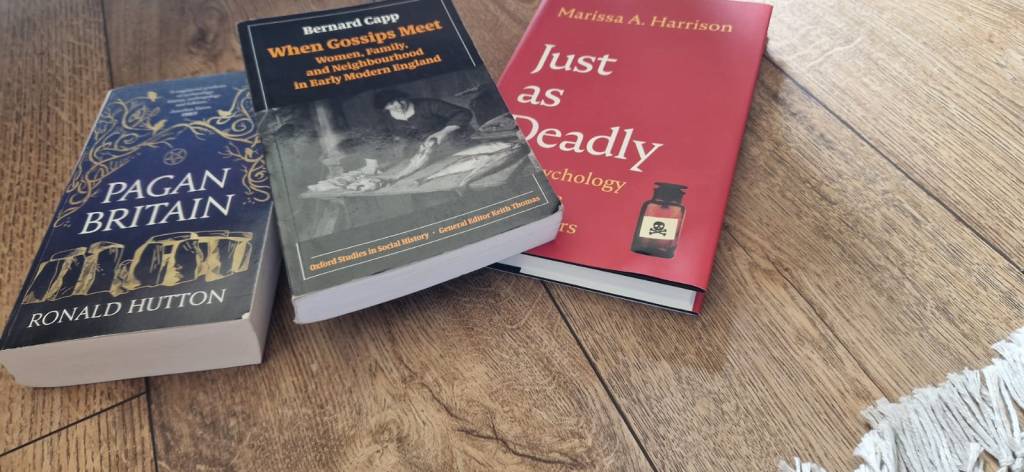
This post began as a celebration and we don’t want to depart on a sombre note. A little less seriously – but still in earnest, if that isn’t too much of an oxymoron – today is National Read a Book Day in the UK. Readers may think we are stretching things a bit to include this in a post about trends in academia and academic publishing; but we’d like to snatch the opportunity to celebrate a phenomenon that has been around for some time and is suddenly enjoying its moment in the limelight: the crossover book. To refresh memories, crossover books are publications primarily designed for the academic market that can be read with pleasure by the general reader. Several academic publishers have recently realised there is huge potential in this market and have stepped up their publication programmes accordingly. Top of my list today is Just as Deadly, by Marissa A, Harrison (Cambridge University Press, 2023), a book about female serial killers that fascinates by showing how different they are from male serial killers (some readers may know I have a professional interest in murderers). Recently I have also read Pagan Britain, by Ronald Hutton (Yale, 2014), a gripping account of prehistory Britain that does not parade the author’s encyclopaedic knowledge of the subject (though I’d be impressed if anyone could read it in a single day). My all-time favourite is When Gossips Meet, by Bernard Capp (OUP, 2003), a riveting and unforgettable account of how women stuck together and supported each other with wit, humour and honesty in order to negotiate successfully the restrictions of patriarchal society in the early modern period. Topical. T should read it!
[written by Linda Bennett]
 Gold Leaf