

Academic librarians are not only law-abiding but also extremely well-informed. Academics have long relied on librarians’ support as they navigate the choppy waters of open access and copyright; and the recent addition of Artificial Intelligence to the scholarly publishing landscape has made the librarian’s contribution yet more invaluable. Publishers are also deeply indebted to librarians for upholding copyright standards and protecting them and their authors from the misuse of research.
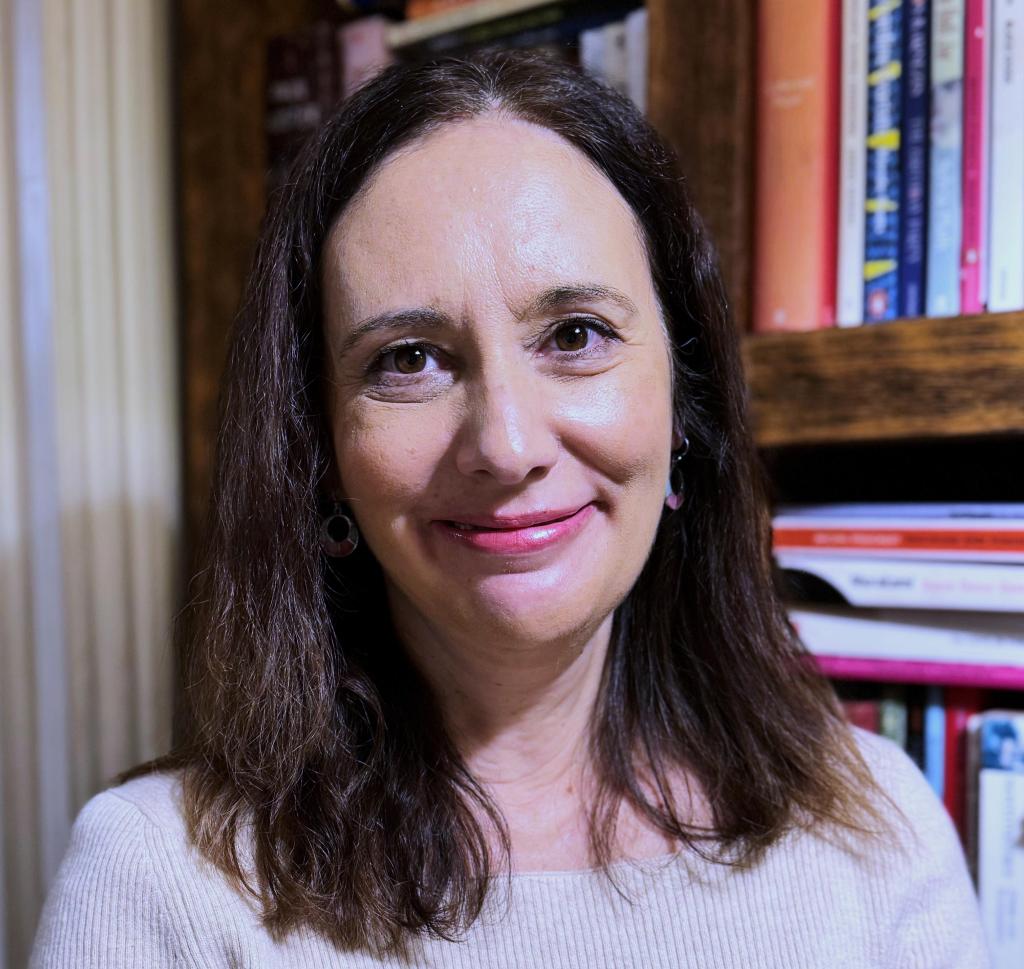
Most senior librarians devote a great deal of time and thought to understanding, explaining and upholding copyright; but few have made it as much the focus of their careers as Dr Christina Daoutis, who is the Copyright Support Officer at University College London. We asked Christina to explain her role and her views on copyright and AI.
LB: Please tell us a bit about your career and how it developed. How did you become involved in such a specialised area of scholarship? Is it something that has always fascinated you, or was it a case of picking up an opportunity and running with it?
CD: I did not qualify as a librarian. I was a researcher and was awarded a PhD in Psychology. Then, 20 years ago, I saw an advert published by the University of Surrey Library, asking for applications for someone to take up a role to explore and support open access, which was relatively new at the time. It seemed exciting and I wanted my career to go in a different direction, but I had no idea that I would stay in this field. I have never pigeonholed open access and scholarly communications by using those terms, but I quickly understood that a core common factor is copyright – it connects academics to publishers and issues related to publishing both within the institution and outside it. It is not common to be exclusively devoted to this area and at first I wasn’t. I became increasingly interested in copyright literacy and how it can be a key to opening up research. Over the years, as open research evolved, other areas such as rights retention and open licensing brought copyright considerations even more to the forefront.
My role in open research was very broad and copyright was only part of it. When, three years ago, UCL advertised for a copyright support officer, I saw the opportunity to focus entirely on copyright – but although I really wanted the job, I didn’t anticipate how interesting and varied it would be, especially as – soon after my appointment – GenAI exploded. My job is also very diverse, even though it is all about copyright: it includes advising on publishing agreements, licensing publications and data, reviewing archive policies, managing copyright in dissertations, educational resources and websites; running sessions for various UCL audiences; developing playful and accessible copyright resources and games and, more recently, setting up a community to develop copyright literacy across UCL. It is a very creative, innovative environment and this is reflected in the variety of projects I get involved in.
LB: Publishers really value librarians as excellent custodians of copyright – and it would appear that academics often don’t have the time – or perhaps the inclination – to explore the detail for themselves. How do you explain copyright to academics, including their own rights as authors? What sorts of questions do they ask you?
CD: I spend a lot of time talking to academics – and you’re right, they’re not always enthusiasts. Many years ago, an academic asked me to make copyright “go away”. Researchers and lecturers are busy and this needs to be acknowledged and built into the training and support I develop. Having said that, copyright is becoming more directly relevant in academic practice and people are increasingly likely to see its relevance before issues arise.
There are different audiences within the scholarly landscape which need appealing to in different ways. Most academics come to me with a problem, whether it’s about ownership, licensing or using images for theses or articles. But the real challenge is to convey the message that copyright is relevant to those who have not come across a problem yet. Copyright literacy is an invaluable skill to develop before issues or questions emerge.
The best approach is to anticipate the issues and offer education and support that is meaningful to diverse audiences – academics, students, researchers, professional services staff – also acknowledging that there are cultural differences: different people have very different ideas about IP. I have discovered that how a session or resource is labelled and promoted is crucial. for example, a generic session on copyright in itself may not attract interest, but hands-on sessions on “copyright for your research data” or “copyright and GenAI” will.
LB: Do you think that academics’ – and publishers’ – copyright is threatened by Artificial Intelligence? Or are there ways of safeguarding it? And again, how do librarians – and particularly you, as an expert – address this?
CD: There are certainly ways of addressing AI, but the question is not an easy one. People feel in the dark – and therefore, threatened by – different aspects of AI, including biases, inaccuracy and misperceptions, and ethical and environmental issues. There is a lot of uncertainty about the effects of AI and these are not confined to IP.
Many stakeholders have a say in the AI debate, but it has been very much led by the creative industries, which have different aims, practices, models and even values from academic research. There are, of course, overlaps, but the various sectors need to be addressed differently.
In my experience, academics feel uncertain about what happens if their research is used to train AI models. There is a lack of transparency which is not helpful here. Then it is a question of attribution – to what extent can publishers assure authors that their research will be properly attributed by AI? While AI models are evolving to link material back to the original author, the capability of different tools to address this is currently questioned.
Overall, most originators of content say they want some control. It therefore becomes a very emotional subject. Currently ways are being developed of creating more transparency and awareness – but perfecting this will take time.
This is a challenge for me: I need to convey the potential benefits and opportunities AI presents while also addressing the concerns. It is a fine balance to translate into guidance.
LB: What is your personal view on AI? Do you think that on the whole it is beneficial?
CD: My view is that AI can be a force for good, but transparency is key. It has tremendous potential to help disseminate research more efficiently and quickly, and also – despite the well-publicised instances of abuse – make it less biased. In my view AI might represent one step further than open science – but it’s difficult to assess how different this one step makes it. Like open science, it can open up wonderful opportunities, save lives, offer solutions to complex problems and lead to unimaginable discoveries. At the same time, there is also the potential to cause harm. Much of the concern is about the speed and scale in which information is being processed. This makes us consider whether there is a difference between application by humans and application by machines. The regulations and checks that humans can enforce are crucial.
LB: How do you instruct academics about AI?
CD: I have recently developed a session entirely on AI at UCL, to encourage discussion around the issues mentioned here. I started by incorporating a bit about it into existing sessions on copyright. One department wanted me to talk more about the implications for their research, which meant more presentations and bigger discussions. Of course, Text and Data Mining [TDM] is also closely related to these discussions, and this is also addressed in guidance I have created. It is important for me to understand and convey the nuances and address the contentiousness of some of these discussions.
LB: How do you see copyright developing in the future? And do you see the librarian’s role developing to meet the changes that will take place?
CD: I think we have to advocate for and embrace significant changes to copyright legislation, some of which is more than 300 years old and no longer fit for purpose. I think that UK copyright law should be reformed to recognise researchers as a specific user category that qualifies them for exemptions and legitimate secondary use.
This will take time, but in the meantime, copyright literacy – among information professionals, researchers, academics and students – is important. Copyright literacy (led by Jane Secker and Chris Morrison in the UK and supported by so many others) is quite a big development, and librarians are at the forefront of picking up on the interest in this.
Copyright literacy should focus on the flexibility copyright offers through exceptions and interpretation. We must highlight that copyright is important – as a compliance issue but beyond that, and, as certain law cases currently passing through the courts demonstrate, it is important to understand the views of different parties.
How we think about copyright is constantly being revised and needs to be adapted to the context of AI, and to keep on being revised. The librarian’s role is to keep up with the developments, digest this information and work with others to address implications for research and education. These new developments enhance the role of librarians and as a sector we already master so many different areas – curation, education, advocacy, enforcement. That’s why I’m certain we can succeed. Over the years librarian roles have evolved to support systematic reviews, assist with TDM, and now address AI as well. Librarians already have a higher profile than before – people are much more aware of their roles.
LB: Do you think that in the long run authors will be better off?
CD: That depends on what “better off” means – it takes us back to the purpose of research. Is it to benefit the world as a whole? If so, there are immense possibilities, despite the concerns. If ‘better off’ is about the author’s reputation, recognition and remuneration, regulations and appropriate technology must be in place has to find ways of keeping up with that and supporting it. Royalties, patents and attribution all need to be addressed.
LB: How do you see the future for publishers taking shape within this context?
CD: It’s difficult to say. I think that the rise of university presses will continue to gather strength and we will see innovative business models emerge, such as Diamond OA (the model adopted by UCL Press). All the issues currently being discussed about rights retention and open access may make some traditional publishers feel threatened, but they have at their disposal many other ways of adding value. Change takes place on many levels – for example, we need a more responsible apparatus for the assessment of research and better methods of dissemination, and publishers can certainly carve out a role for themselves in this new world.
LB: Do you ever find time to relax?
CD: Certainly, but my tendency to think about ideas and concepts follows me outside work: I love reading and watching films but this, interesting and exciting as it can be, is not always relaxing! Music, cooking and just spending time with family and friends (preferably not talking about copyright and AI!) is what makes me truly switch off.
LB: Dr Christina Daoutis, thank you very much indeed for this fascinating insight into the librarian’s role in copyright.
[This interview was first published by De Gruyter Brill here.]
 Gold Leaf