

On occasion the world of academic librarianship produces thought-leaders who dominate their profession, sometimes regionally, sometimes globally, for decades. Two such distinguished librarians are Mrs Lee Cheng Ean, who was University Librarian and Immediate Past University Librarian at the National University of Singapore [NUS] until 2023 and now holds the role of advisor and ambassador for the university libraries until she retires, and Ms Roxanne Missingham, University Librarian at the National University of Australia [ANU], who retires on 14th February this year.
We asked Mrs Lee Cheng Ean and Ms Missingham to describe the most significant experiences of their respective careers. Their responses are fascinating!

Mrs Lee focused on the advent of electronic journals. This is usually described as a watershed moment for academic librarianship and publishing, often accompanied by the tacit assumption that it happened overnight as a ‘done deal’. Mrs Lee’s response demonstrates that nothing could be further from the truth; and observes that electronic journal access was just the first part of a continuum that leads to (but does not end with) the use of AI in libraries today.
“My career at NUS Libraries has given me a front-row seat at the dramatic evolution of journal access. It’s a story of digital transformation, from card catalogues to the complexities of open access and AI-driven licensing.
“I joined NUS Libraries as a Trainee Librarian in December 1981 and was immediately immersed in helping to set up its first library system, MINISIS. NUS Libraries was a pioneer, the first comprehensive university library in Southeast Asia to adopt this free platform. With over a million items to catalogue, we still had to rely heavily on the card catalogue while gradually migrating data to the automated library system.
“In 1989, we upgraded to the licensed SEA-URiCA system to continue the long process of data migration. By June 1995, now as Head of Serials, I faced a major challenge: migrating our manual print journal records to our first fully integrated system, Innopac. This meant spending countless long hours, including many late nights, preparing serials records for the system. We later upgraded from Innopac to Millennium in 1998, and then to Sierra in 2013. We are still using Sierra today.
“The Innopac implementation caused a steep learning curve. I had to master the system’s parameters and attributes to predict accurately journals publication dates. This involved meticulously reviewing printouts, matching them against existing manual records in the visual index (Visiblex), and then coding them for entry into Innopac. A key part of this process was developing user-friendly manuals and training staff on how to create bibliographic, order and check-in records using precise technical information. Accuracy was paramount, as this information became accessible to library users immediately.

“Innopac’s comprehensive serials management module revolutionised our workflow. It streamlined journal issue receipt and payment tracking and enabled price comparisons between subscription agencies. This allowed us to optimise consolidation services and begin our transition to a mixed print and electronic journal subscription model. We actively sought electronic access wherever possible, laying the groundwork for expanding online access and negotiating “big deals” to include both subscribed and non-subscribed journals by the late 90s.
“The 2014 Swets bankruptcy was a stark reminder of how volatile the journals landscape had become. Fortunately, because we negotiated directly with publishers and could establish online access through their platforms, we were able to mitigate the effect of the disruption. This experience confirmed our commitment to a fully electronic model, leading us eventually to discontinue most print subscriptions.
“The journey from print to electronic has been far from smooth. Negotiating favourable terms requires strong, trust-based partnerships with publishers. The rise of transformative agreements presents another challenge. With no additional funding for publishing, we have focused on negotiating Read and Publish agreements and securing limited or unlimited APC waivers without incurring extra costs.
“The impact of AI on licensing agreements has now become an evolutionary factor. As well as text mining, some publishers now permit the use of AI tools (within defined boundaries). We must consider carefully these developments as we negotiate future agreements.
“From the early days of card catalogues to the sophisticated systems of today, the development of library systems, journal subscriptions, academic publishing, and the exponential growth of AI have profoundly shaped how NUS Libraries provides access to information. It is a continuous process of adaptation and innovation, ensuring that our community has access to the resources they need.”

Ms Missingham focused her thoughts on the complex web of relationships that academic libraries must forge.
“I have been thrilled to be a member of the library and scholarly communication communities for more than 50 years. Every day has been fulfilling, with new opportunities to transform services through a wide range of conceptual and technical developments.
“I’d like to focus especially on some of the issues and people who have changed my thoughts about librarianship and their effect on the impact librarians can make.
“Partnerships is something that we don’t talk about often enough. No library could deliver successfully without the wonderful publishers and vendors that work tirelessly to provide content and systems. In the past, library suppliers would have amazing stocks of treasures that we could wander through, either in person or via print catalogues. Their passion in supporting libraries and personal collectors was outstanding. We explored the expanding boundaries of content management together. The move to electronic access opened up a world of content where daily interactions with publishers and vendors reshaped access and innovation removed barriers to new publications. Who would have thought that we would place records in electronic catalogues so our users could request the titles they need and get immediate access without tedious forms and processes?
“The development of new acquisition models (DDA, EBA) has more than doubled the use of publications – resulting in happy readers and happy librarians. I’d like to acknowledge the work of both publishers and aggregators in perfecting these models. It is vital for librarians to engage positively with publishers and vendors and respond with bravery when new models are introduced, to test them and support change.
“The support of our readers is essential to the improvement of library environments. Listening to students has been a great source of ideas and inspiration for me. I’d like to thank all the student leaders who have provided advice, particularly while members of our Library Advisory Committee. Here are a few examples: past presidents of our student associations have respectively suggested and supported funding for lap top loans, new programs for higher degree by research, subscriptions to international newspapers to connect students to their communities, 24-hour opening and a new textbook equity project. Their outstanding enthusiasm and constant engagement helps us think beyond traditional services. Going beyond the traditional library surveys and focus groups by building strong relationships through regular engagement has produced some brilliant outcomes.
“Moving to libraries more generally, the stand-out success for all academic libraries has been the ability to throw open our doors digitally. I’m not just talking about publishers’ collections, great though they are, but also the digitisation of our own unique collections. I’d like to acknowledge the work of Jan Fullerton in her role as Director General of the Australian National Library in leading in a massive Australian newspaper digitisation project and creating, with Warwick Cathro’s vision and leadership, an infrastructure that has enabled digitised material to be accessible and usable for all. Their vision inspired me to make other bold, innovative decisions.
“I am very proud to have been responsible for the digitisation of the complete parliamentary record – Hansard – making it available to our nation as a record of the foundation of our democracy. At ANU we have transformed access to deep research by digitising all PhD and many Masters’ theses. More than 70% of our downloads are of digitised theses: this has grown from approximately zero to 100 downloads per year per thesis. They are invaluable sources for further research and citations and demonstrate the impact of the library’s holdings. Libraries can make an enormous difference to their institutions through promoting activities that contribute to the dissemination of knowledge and improved community awareness.
“No library is an island. Every library is made stronger by collaboration. I was delighted to have been able to allow access to more than 6,000 ANU research works via the HathiTrust by obtaining copyright permission. Using knowledge of international projects to broaden access to collections is a key contribution from modern librarians. Our knowledge of and input to copyright legislation and institutional policies give us unique influence. Using this knowledge to grow global solutions contributes enormous uplift to the scholarly communications ecosystem.
“In addition to thinking globally about access and collections, it is important to take time to think about how we can contribute personally. I am deeply grateful for the opportunity to contribute to building stronger library education in Myanmar and the work I have done with Dr Ni Win Zaw, University Librarian, University of Yangon and her colleagues is very special to me.
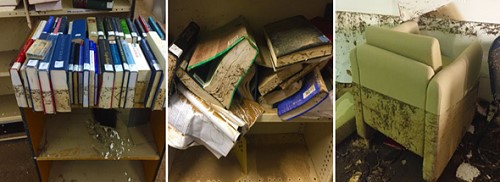
“Finally we should acknowledge that dealing with disasters make us stronger. When I commenced my career I didn’t think I’d be dealing with a flood that destroyed around 330,000 volumes, bushfires that closed the campus, hailstorms that destroyed the roofs of all the libraries, massive insurance claims, electrical fires and more. From these experiences I learnt the importance of being present, calm, collegial and stepping up to take responsibility – and I discovered the warmth and efficacy of support from the local community when given the chance to connect with the university.
“To all my colleagues in libraries, publishing, library supply and systems and user thank you for all the collegiality, support and inspiration you have provided.”
We know that all the readers of this blog wish Mrs Lee Cheng Ean and Ms Roxanne Missingham every joy and success in the next stage of their respective journeys!
This blog post was written by Linda Bennett and first published on the De Gruyter Brill “Conversations” blog.
 Gold Leaf